
v0.2.1 · Now on PyPI
RagBucket
Portable executable .rag artifacts for Python. Package your entire RAG pipeline into a single file. Build once. Load anywhere.
$
uv add ragbucket
scroll
Portable executable .rag artifacts for Python. Package your entire RAG pipeline into a single file. Build once. Load anywhere.
ML models travel as single files — .pt .onnx .gguf .h5 — saved, shared, deployed anywhere.
RAG pipelines don't. They're a web of infrastructure, scattered config, and provider lock-in.
A compressed, self-contained archive that packages your entire retrieval system. Vectors, chunks, and config — everything in one file. The only external dependency at inference time is an LLM API key.
Two completely decoupled phases: build-time artifact generation and runtime retrieval + generation. The artifact is the bridge.
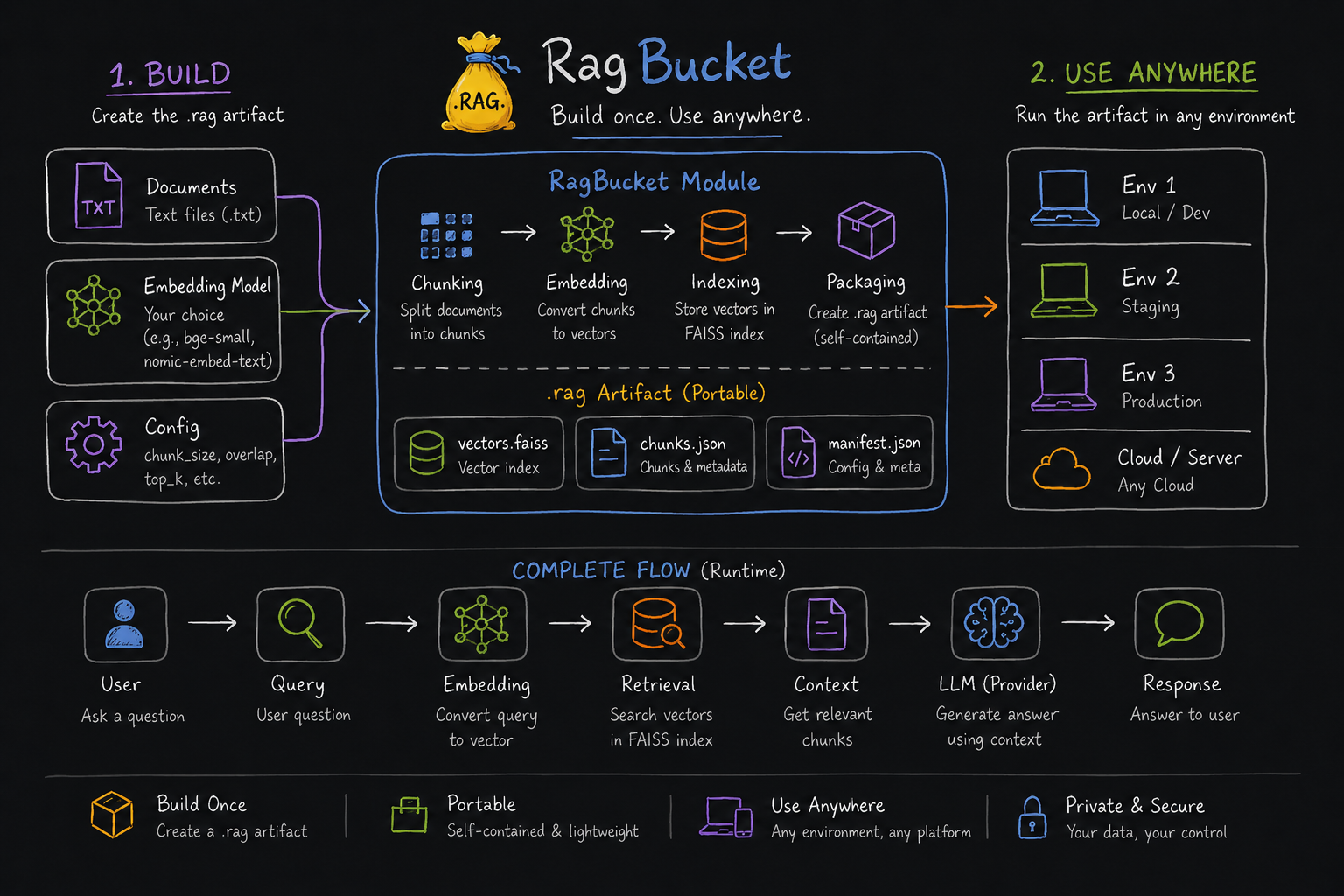
Build your artifact from documents. Load and query it anywhere — with any LLM provider.
from ragbucket import RagBuilder, RagConfig

# Configure the pipeline
config = RagConfig(
    embedding_model="BAAI/bge-small-en-v1.5",
    chunk_size=512,
    chunk_overlap=50,
    top_k=3,
)

# Build the .rag artifact
builder = RagBuilder(config=config)

builder.build(
    doc_path="docs/",       # folder of .txt files
    op_path="demo.rag",    # output artifact
)

# ✓ demo.rag created
# Contains: vectors.faiss + chunks.json + manifest.json
from ragbucket import RagRuntime
import os
from dotenv import load_dotenv

load_dotenv()

# Load the artifact — works from any environment
rag = RagRuntime(
    rag_path="demo.rag",
    provider="groq",              # groq | openai | gemini | anthropic
    api_key=os.getenv("GROQ_API_KEY"),
    model="llama-3.1-8b-instant",
    system_prompt="You are a helpful assistant.",
)

# Ask anything
response = rag.ask("What are Anik's AI/ML skills?")
print(response)
from ragbucket import RagConfig

# All fields are optional — defaults are sensible
config = RagConfig(

    # Any Sentence Transformers compatible model
    embedding_model="BAAI/bge-small-en-v1.5",

    # Chunking
    chunk_size=512,
    chunk_overlap=50,

    # How many chunks to retrieve per query
    top_k=3,
)

# Supported embedding models:
# "BAAI/bge-small-en-v1.5"          fast, great for English
# "BAAI/bge-base-en-v1.5"           balanced quality/speed
# "sentence-transformers/all-MiniLM-L6-v2"
# "sentence-transformers/all-mpnet-base-v2"
Plug in any LLM provider, any embedding model, any vector store. RagBucket handles the wiring.